
Does Anyone Have to Buy Your Token? RWA Fees, Burns and Buybacks Across 300 Coins
Updated 12 October 2026
Does anyone have to buy your token?
Every XRPL transaction requires XRP. Over the trailing year, that forced about $259k of fee burn against an $86.07B market cap. 0.0003%. A token can be mandatory and still see tiny measured demand against its valuation.
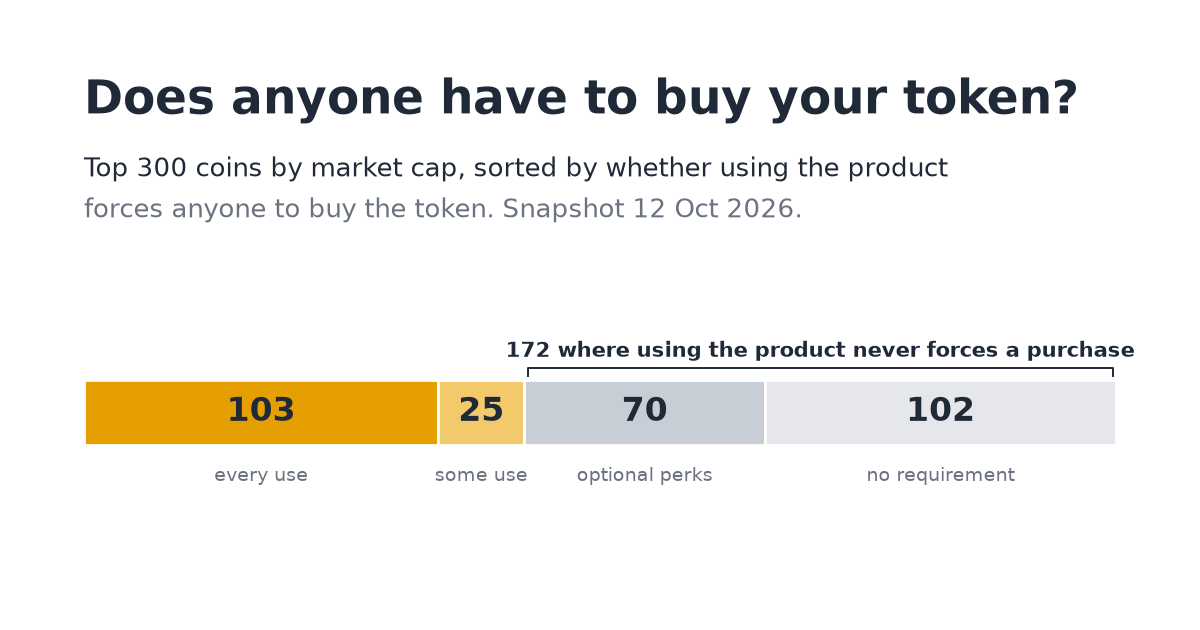
I checked 300 crypto assets. 102 have no token requirement at all. Another 70 only offer optional perks. That is 172 of the top 300, more than half, where using the product never forces anyone to buy the token. On the other side, 70 tokens have a measured flow of fees that must be paid in the native token, and just nine of those reach required annual fee demand worth at least 0.5% of their market cap.
A protocol can have customers, revenue and real-world assets on-chain without creating much demand for its own token. It can also burn tokens without asking a single user to hold one. Follow the payment: who has to acquire the token, for what, and how much?
Every coin's score, fee figure and source is in the full 300-token ranking.
A need score is not a fee number
I graded whether using the product forces someone to spend or lock the token:
| Need score | Rule | Tokens |
|---|---|---|
| 3 | Every use requires spending or locking the token | 103 |
| 2 | Only some use requires it | 25 |
| 1 | Optional perks | 70 |
| 0 | No requirement | 102 |
The universe is the top 300 by market cap after removing stablecoins, wrapped tokens, liquid staking tokens, tokenized funds, stocks and commodities. The market snapshot is 2026-10-12.
A score of 3 says the mechanism is compulsory. It does not say the resulting demand is large. XRP is the clean example. Every XRPL transaction destroys an XRP fee, and accounts need a reserve. Yet the trailing-year burn of 190,706 XRP puts it 67th of the 70 tokens with measured required demand.
At the other extreme, Canton traffic fees are paid by burning CC. The measured required flow was $565.29M over the year, or 11.66% of market cap. An app or validator can buy and burn CC without making every end user hold it. The economic requirement survives the abstraction. The user-facing requirement does not.
The test is simple. Does the service work if the customer never touches the token? If yes, does a sponsor or operator still have to acquire it behind the scenes? Or does the token only receive revenue later, through a buyback?
Fees make the size visible
I put annual required token fees beside market cap. The fee flow is measured in native units and valued at the snapshot price. A high score with a tiny fee ratio is still a small measured flow.
| Token | What use requires | Required fee demand, trailing year | Share of market cap |
|---|---|---|---|
| CC | Traffic burn on Canton | $565.29M | 11.66% |
| POL | Polygon PoS gas | $31.09M | 2.85% |
| TRX | Network resources | $364.32M | 1.16% |
| SOL | Network fees | $252.86M | 0.398% |
| ETH | L1 gas, including L2 blob fees | $188.15M | 0.061% |
| XRP | XRPL transaction fees | $259.4k | 0.0003% |
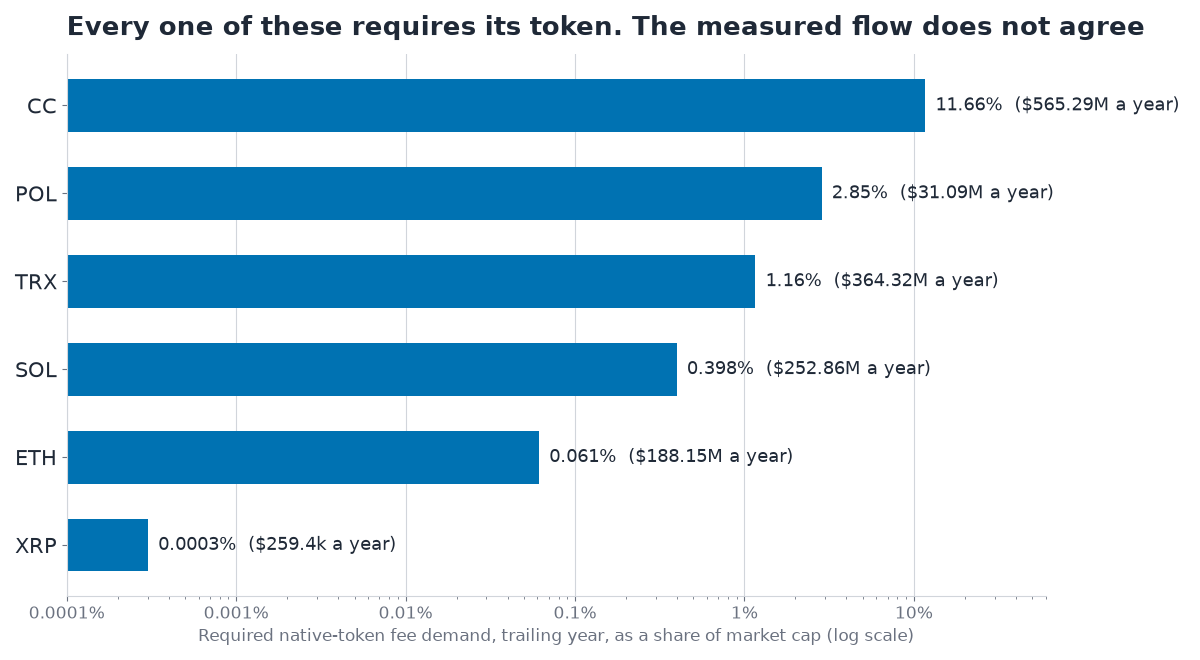
These are not interchangeable revenue figures. A required gas payment measures a flow through the token. It does not tell you what the protocol retains, what validators receive or what remains after issuance. It tells you the scale of one compulsory flow against the token's market value.
TRX is a useful contrast to XRP. Both are compulsory for their networks. TRX's measured required fees were $364.32M, or 1.16% of its market cap. XRP's were 0.0003%. "Required" alone misses that gap.
Get the daily brief
One email each morning: the scores that moved overnight, the coins that crossed a rating band, and the next big token unlock.
Double opt-in. Unsubscribe in one tap.
RWA market cap does not become native-token demand
A tokenized security or fund can sit on a chain without its owner ever buying the chain token. The issuer may pay gas. An app may sponsor it. Some chains use another token for gas altogether. And a record representing an asset is not the same thing as that asset trading or generating recurring fees.
The RWA estimates are ceilings, not measured RWA transaction fees. Actual RWA fees are likely lower.
| Network token | RWA on-chain total | Distributed RWA | Upper-bound est. RWA native fees / yr | Share of token market cap | Who needs the token? |
|---|---|---|---|---|---|
| CC | $316.52B | $0 | $565.29M | 11.66% | App or validator pays and burns CC; asset holder need not hold it |
| HASH | $23.22B | $75.95M | $1.74M | 0.50% | Issuer pays HASH gas |
| ETH | $16.63B | $16.54B | $13.56M | 0.0044% | Gas payer uses ETH |
| SOL | $4.48B | $4.35B | $39.89M | 0.063% | Gas and rent deposit use SOL |
| XRP | $4.60B | $501.15M | $75.7k | 0.0001% | Reserve and transaction fees use XRP |
| ARB | $1.06B | $1.03B | $0 | 0% | No native ARB fee; gas is paid in ETH |
Canton stands out on required native fees. The $565.29M figure assigns all measured CC traffic burn to RWA and institutional activity; it is a ceiling, not a count of RWA-only fees. Its $316.52B on-chain figure is represented ownership records, with $0 distributed in this data. Provenance records $23.22B on-chain but $75.95M distributed; XRPL records $4.60B but $501.15M distributed. A record of an asset is not a purchase of the native token.
ONDO shows the same split from the other side. Its tokenized assets can be bought with fiat or stablecoins; ONDO is governance. Arbitrum has RWA value on-chain, but gas is paid in ETH, not ARB. The RWA business and the native-token requirement can part ways completely.
A burn is not always a new buyer
I split burns into two paths.
Usage-forced burn: using the network forces a token payment and destroys some or all of it. That payment is already in required demand. Canton traffic burn and TRX resource-fee burn belong here. Adding the same burn on top of required demand would count it twice.
Holder-side burn or buyback: users pay in something else, then protocol revenue funds token purchases or burns. That can matter to holders. It does not make the token necessary to use the product.
| Token | Need score | Verified mechanism | Trailing-year burn or buyback as share of market cap |
|---|---|---|---|
| CC | 3 | Usage-forced traffic burn, already in need | 11.66% |
| TRX | 3 | Usage-forced resource-fee burn, already in need | 1.16% |
| PUMP | 0 | Revenue-funded buyback and burn | 11.72% |
| GMX | 0 | Buyback and distribution | 8.30% |
| UNI | 0 | Fee-switch burn | 1.22% |
| HYPE | 2 | Assistance Fund buybacks alongside limited required token use | 3.84% |
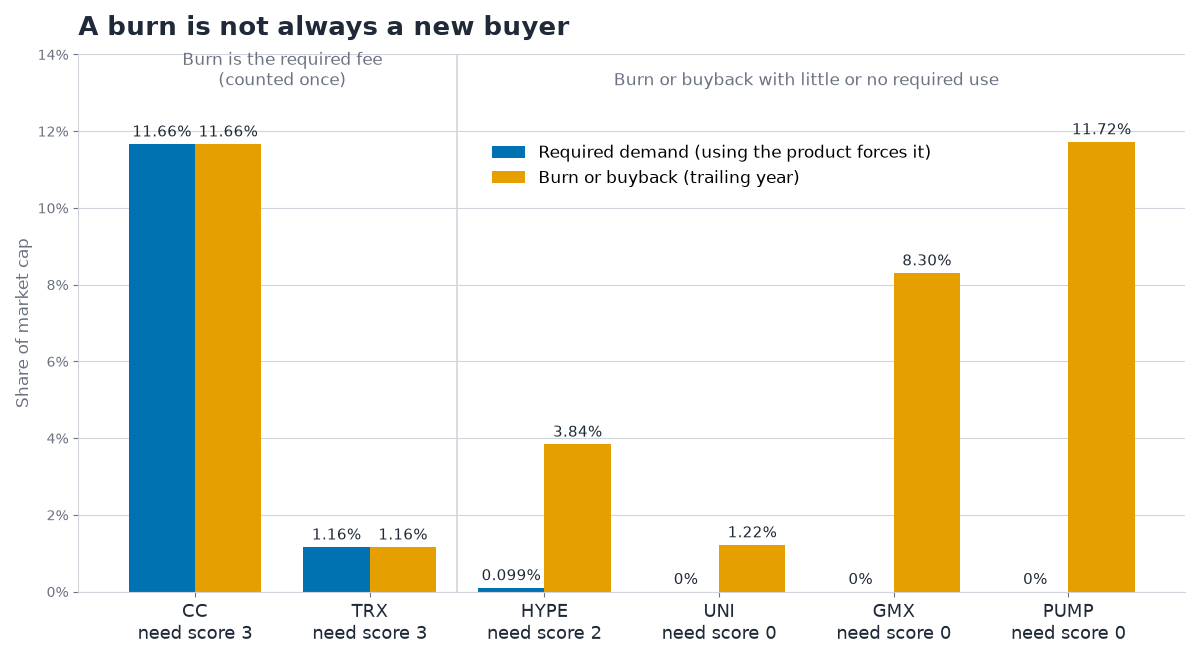
PUMP makes the distinction hard to miss. Users launch and trade with SOL, not PUMP. Its need score is 0. Its program buys and burns PUMP with 50% of net revenue. The verified trailing-year buyback and burn was $283.79M, or 11.72% of market cap. That is a holder-side mechanism, not compulsory product use. The earlier treasury burn was a one-time event and is not in the run rate.
UNI's fee switch is live. Fees accumulate in TokenJar and can be released by burning UNI through Firepit. Swappers still pay in the assets they trade; they do not need UNI to use the exchange. UNI keeps a need score of 0 despite a 1.22% trailing-year fee-switch burn relative to market cap.
HYPE is different again. Perpetual trading fees are paid in USDC, while HYPE is needed for some other uses, including HyperEVM gas. Its measured required flow was $18.38M, or 0.099% of market cap. Its total burn and buyback was $714.42M over the trailing year, 3.84% of market cap, and $696.03M of that was holder-side Assistance Fund buybacks. Calling those buybacks "required trading demand for HYPE" puts the wrong mechanism on the right number.
BNB's quarterly Auto-Burn needs a separate label too. It is formula-based and uses foundation-held tokens, not an open-market purchase triggered by a customer paying a fee. It belongs in a burn discussion, not in the number of BNB a user was forced to buy for gas.
Burns do not erase issuance or unlocks
Among 94 score-3 tokens with CoinGecko circulating-supply history, 82 grew circulating supply over the prior year, 12 shrank, and the median change was +4.7%. Most tokens with compulsory use still grew circulating supply. For the mechanics, see Token Unlocks Explained.
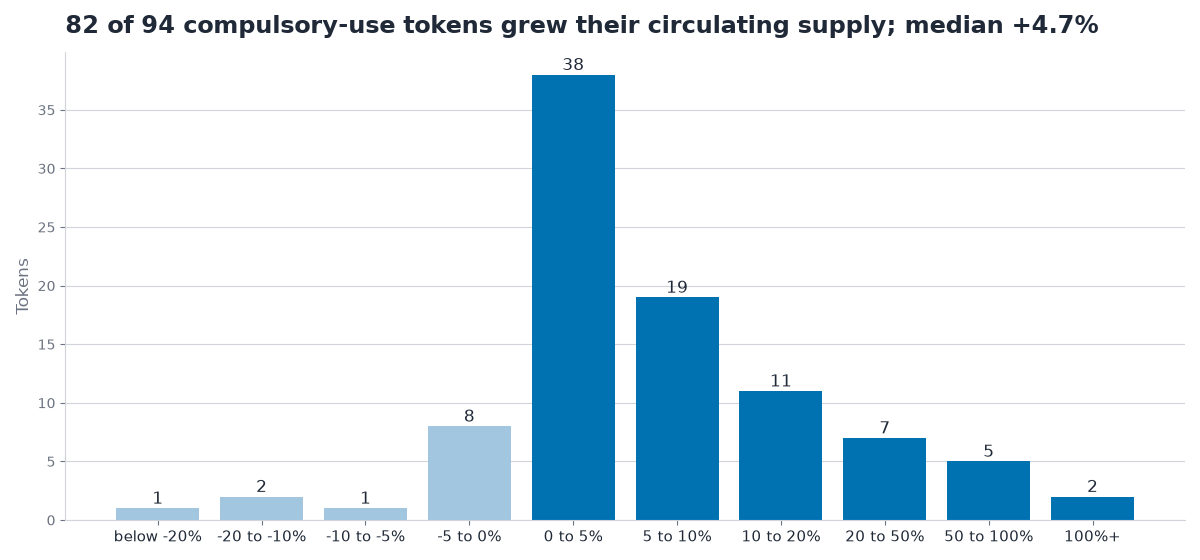
PUMP shows why a burn headline alone can mislead. The report records total supply down about 17%, while CoinGecko circulating supply is up 31%. Unlocks and a CoinGecko reclassification drive the difference. HYPE's apparent circulating-supply drop also includes an accounting recognition and a data-method change. Neither headline is a clean measure of new buying or net token destruction.
What I would check before calling a token "needed"
I would ask these in order:
- Who pays? The user, an app, a validator or a fee-funded treasury?
- What do they pay with? The native token, stablecoins, fiat or another chain's gas token?
- Is acquisition compulsory? Can someone use the product without the token, and does an operator still have to source it behind the scenes?
- How large is the flow? Put required native fees beside market cap. Keep locked reserves separate from annual spending.
- Where does the fee go? Burned, paid to validators, paid to a protocol treasury or used for a later buyback?
- What happens to supply? Check issuance and unlocks before claiming scarcity.
Method and limits
This is one market snapshot: CoinGecko Pro, 2026-10-12 at 17:12 UTC. Required-fee data cover 2025-10-12 through 2026-10-11. The short-window annualization uses 2026-09-12 through 2026-10-11. The ranking combines the compulsory-use score with required fee demand divided by market cap. I use its components here, not the composite, because a single rank would blur the mechanisms this article is trying to separate.
RWA data are from 2026-09-27; fee and market-cap data are from 2026-10-12. For the table, I estimated RWA native fees by multiplying required chain fees by the distributed RWA share of distributed RWA, stablecoins and DeFi TVL. Canton and Provenance use the full fee flow as a ceiling. These are not measured RWA transaction fees.
Staking data, the HNT run rate, ETH issuance and some supply histories were not refreshed after the earlier September pull. HNT's $3.47M annual figure is a Q2 exit-rate estimate, not a fee series refreshed in October. VIRTUAL's 2.79% need ratio rests on a low-confidence assumption. Circulating supply also moves with unlocks and data-provider reclassifications; the history mostly ends on 2026-09-26 and was not refreshed for this run.
New arrivals in the top-300 screen had only a quick review. Fee-source confidence varies. I left unverified burn and buyback candidates out of the examples. One-time burns and staker distributions are not recurring buyback run rates.
The test measures mechanisms and observed flows. It does not show whether any token is cheap, whether a burn will outrun future issuance, or what its price will do next.
FAQ
Does an RWA on a blockchain create demand for the chain token?
Only if some part of issuing, moving or holding it requires that token. The asset holder may never touch it. The app or issuer may pay gas, and on some chains gas uses another token entirely.
Are token burns the same as fees?
No. Some fees force a native-token purchase and burn at use. Other protocols collect fees in different assets and later buy or burn their token. The first is compulsory use; the second is holder-side value accrual.
Does a high need score mean high token demand?
No. XRP requires its token for transaction fees, but its measured trailing-year burn was 0.0003% of market cap. Need tells you whether payment is compulsory; the fee ratio tells you how large the measured flow is.
Can a token have no required use and still benefit from protocol revenue?
Yes. PUMP and UNI have need scores of 0 in this test. Both have verified burn mechanisms funded by revenue or fees. That does not make either token necessary for a customer to use the product.
Not financial advice. Educational only.
Get the daily brief
One email each morning: which scores moved overnight and by how much, which coins crossed a rating band, and the biggest token unlock coming in the next 30 days. A free account adds a watchlist so the brief follows your coins.
Double opt-in. Unsubscribe in one tap.
See this on real coins. Cyclesolved scores every coin in the top 300 with enough data across five categories and shows every input behind the number.