
FDV vs market cap in crypto: is a low MC/FDV good?
Updated 15 September 2026

You look up a coin and see two numbers.
Market cap is $800M.
FDV is $8B.
People treat that gap like a verdict. It isn’t. It is a prompt to ask better questions about supply.
This page explains FDV, market cap, and MC/FDV. It also gives you a practical workflow you can use without predictions or price targets.
TL;DR
- Market cap uses circulating supply.
- FDV uses max supply or total supply. It depends on the data source.
- MC/FDV is a dilution lens. It is not a buy or sell signal.
- Low MC/FDV is not automatically good.
- There is no universal “healthy MC/FDV ratio.” Timing does most of the work.
Is a low MC/FDV good?
Sometimes.
Low MC/FDV means a lot of supply is not circulating yet, relative to the supply used for FDV. That supply can arrive through unlocks, emissions, or both.
The ratio does not tell you how fast that happens. It also does not tell you who receives the tokens. Those two details decide whether dilution is a real near-term headwind or just a long-dated background factor.
Case 1: Low MC/FDV because dilution is real
This is the common case.
- A large share of tokens is locked.
- Those tokens unlock over time.
- More tokens become available to sell.
That does not make a project bad. It does mean the supply pipeline matters. If you are ignoring it, you are guessing.
Case 2: Low MC/FDV but supply arrives slowly
This can be fine.
Some projects distribute supply gradually. Some have emissions that are predictable and declining. Some have demand drivers that can offset new supply.
The mistake is treating “low MC/FDV” as the conclusion. It is not. It is the first question.
What is a “healthy” MC/FDV ratio?
There is no single number you can memorize.
The question you actually care about is simple.
Will supply grow faster than demand over the next 6 to 18 months?
MC/FDV is a rough proxy for “how much supply is still ahead.” It does not contain timing. It does not contain distribution. It does not contain incentive structure.
So use MC/FDV to decide what to investigate, not what to believe.
| MC/FDV shape | What it often means | What you check next |
|---|---|---|
| Very low | supply story dominates | unlock timing, emissions, recipients |
| mid | mixed | net new supply vs usage growth |
| high | dilution less central | demand durability, liquidity, sinks |
If you want a single rule, here it is. The faster supply arrives, the more MC/FDV matters. The slower supply arrives, the more everything else matters.
Why is FDV so high?
FDV gets high for arithmetic reasons.
Max supply is large. Circulating supply is small. Price is non-trivial. Multiply them and you get a big number.
The trap is treating FDV like a real valuation you could liquidate into. FDV assumes today’s price applies at full scale. Thin markets do not behave that way. Long-dated supply does not behave that way either.
FDV is best used as a stress test. It answers, “If this supply existed and was liquid, what would this look like?”
That is not reality. It is a hypothetical.
FDV vs market cap (definitions)
Market cap = price × circulating supply.
FDV = price × max supply. Some sources use total supply instead.
MC/FDV = market cap ÷ FDV.
Market cap describes what is priced today. FDV describes what would be priced if the full supply existed at today’s price. The difference between those two worlds is where most dilution mistakes happen.
A worked example
Price is $2.00.
Circulating supply is 100M.
Max supply is 1B.
Market cap = $2.00 × 100M = $200M
FDV = $2.00 × 1B = $2B
MC/FDV = $200M ÷ $2B = 0.10
That ratio does not tell you whether the coin is cheap. It tells you supply is the story. Now you go read the supply schedule.
Token unlocks are the missing link
Most people do not get hurt by the concept of FDV. They get hurt by the calendar.
Unlock schedules tell you how supply enters the market.
- Cliff unlocks release a chunk at once.
- Linear vesting releases it gradually.
- Emissions release supply continuously.
- Burns reduce supply, sometimes. They depend on usage and design.
Unlock does not equal sell. Unlock does increase available supply. If a large share of value is scheduled to unlock soon, you should at least know that before you size a position.
A live example
You can make this concrete. Here is the heaviest 30-day unlock among the coins we hold schedules for, as of today.
That number does not predict price. It tells you what is scheduled to arrive, and when.
The 7 ways FDV misleads you
1) Max supply is not always fixed
Some projects can change it. Others have policies that behave like “no cap” in practice.
2) Total supply vs max supply depends on the source
Two sites can show two FDVs for the same coin. Both can be correct under their definitions.
3) Timing matters more than the final number
FDV might be ten years away. Your risk is often the next 90 days.
4) Recipients matter
Team unlocks differ from ecosystem incentives. Investor unlocks differ from treasury unlocks. Incentives change behavior.
5) Liquidity makes FDV look real when it isn’t
FDV assumes price holds at scale. Thin markets do not.
6) Burns and sinks can offset issuance
Sometimes. Not always. If the burn depends on activity, treat it as conditional.
7) Token types behave differently
L1s, governance tokens, and memecoins can share the same formula and still behave differently. The formula does not give you the context.
A 5-minute checklist to use FDV responsibly
- Compute MC/FDV.
- Find the unlock schedule.
- Identify who receives unlocks.
- Estimate net new supply. Unlocks plus emissions, minus burns if they are real.
- Compare against one demand proxy. Usage, fees, active addresses, TVL. Pick one.
- Write one sentence about what would change your view.
If you cannot find the unlock schedule or distribution, you do not have enough information. You either skip it or size it like you have no edge.
Where Cyclesolved fits
FDV is one input. It is not a strategy.
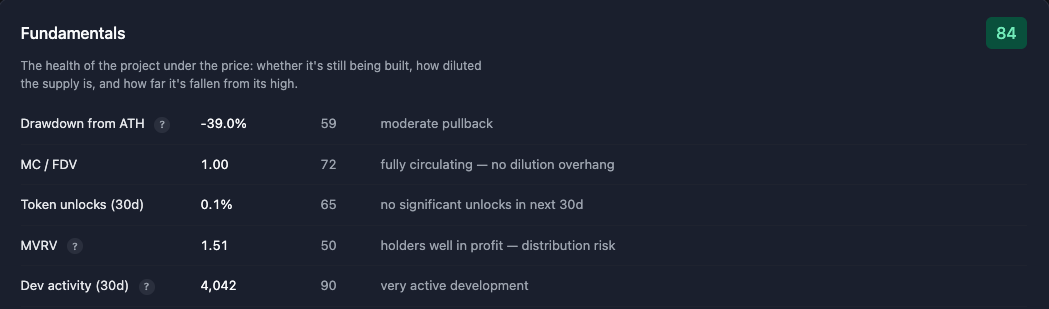
We score coins across technicals, on-chain, fundamentals, sentiment, and macro. You get one 0 to 100 score, and you can open it and see the inputs behind it.
Start here:
Two example coin pages:
FAQ
What does FDV mean in crypto?
FDV is token price multiplied by max supply. Some sources use total supply. It is a hypothetical valuation, not a cash-out valuation.
Does FDV include locked tokens?
FDV uses max or total supply, so it includes tokens that are not circulating.
Is low MC/FDV always undervalued?
No. Low MC/FDV often means future supply matters. It is usually a dilution prompt, not a bargain stamp.
What is a good MC/FDV ratio?
There is no universal good ratio. Timing decides it. Look at unlocks, emissions, and who receives the supply.
Why do some coins have extremely high FDV?
High max supply. Low circulating supply. Non-trivial price. Multiply them and FDV explodes.
Do token unlocks always dump price?
No. Markets can price unlocks early. Recipients do not always sell immediately. Unlocks are still a real risk factor.
Not financial advice. Educational only.
Get this in your inbox each morning
What changed today, emailed each morning: the scores that moved overnight, your watchlist changes, and what's rated Buy.
Double opt-in. Unsubscribe in one tap.
See this on real coins. Cyclesolved scores every coin in the top 100 across five categories and shows every input behind the number.