
Token unlocks explained: what an unlock schedule is and how to read it
Updated 15 September 2026

A token unlock is simple.
Tokens that were locked become transferable.
That can change supply. It can change incentives. It can change price behavior. Not always, but often enough that you should know it is happening.
This guide explains unlock schedules in plain terms. It shows what to look at if you want to avoid dilution surprises.
If you want the companion piece on valuation math, read:
FDV vs market cap in crypto: is a low MC/FDV good?
TL;DR
- An unlock is supply becoming transferable.
- Unlock does not mean sell. It does mean the option to sell appears.
- Schedules matter more than headlines. Timing decides most of the risk.
- “Big unlock” can be irrelevant if it was priced in, or if it vests slowly.
- The questions that matter are consistent: how much, when, and who receives it.
What is a token unlock?
Projects allocate tokens to different buckets. Team. Investors. Treasury. Ecosystem incentives. Sometimes validators or stakers.
Many of those tokens are locked at launch. They unlock later.
An unlock schedule is the calendar of when those locked tokens become transferable.
That is it.
Why token unlocks matter
Supply is part of price. Not the only part. Not always the main part. Still part of it.
When supply expands, the market has to absorb more tokens. Sometimes it does easily. Sometimes it doesn’t.
Unlocks also change behavior. A token that was illiquid becomes liquid. That changes what holders can do, and what they might choose to do.
So the point is not to panic at an unlock headline. The point is to know what you are stepping in front of.
The four unlock patterns you’ll see most
1) Cliff unlock
A large amount unlocks on a single date.
This is the pattern most likely to shock the market, because it concentrates supply in time.
2) Linear vesting
Supply unlocks gradually. Often daily or monthly.
Linear vesting can still be meaningful. It is just easier for the market to digest because it is spread out.
3) Emissions
New supply is issued continuously.
This is not always called “unlocks,” but for your portfolio it behaves similarly. Circulating supply expands.
4) Airdrops and distributions
Sometimes supply appears because of airdrops or planned distributions.
If the distribution is large relative to liquidity, it can behave like an unlock event.
“Unlock” does not mean “dump”
You will hear “unlocks dump price.”
Sometimes they do. Sometimes they don’t.
Three reasons an unlock can have no obvious effect:
- The market priced it in early.
- Recipients do not sell immediately.
- Demand is strong enough to absorb supply.
Three reasons an unlock can hit:
- It is large and concentrated.
- Recipients have strong incentive to sell.
- Liquidity is thin and the market cannot absorb it.
The schedule is not a forecast. It is a risk factor you can measure.
How to read an unlock schedule (the practical way)
You do not need to become an expert in tokenomics to get 80% of the value.
You need three numbers.
1) Next 30 days unlock amount
This is the part that can actually surprise you soon.
2) Next 90 to 180 days unlock trend
Is the supply pressure increasing or fading?
3) Who receives the unlocks
Team and investor unlocks behave differently than ecosystem incentives. Treasury unlocks behave differently than validator emissions.
If you can’t answer “who,” you are missing the most important context.
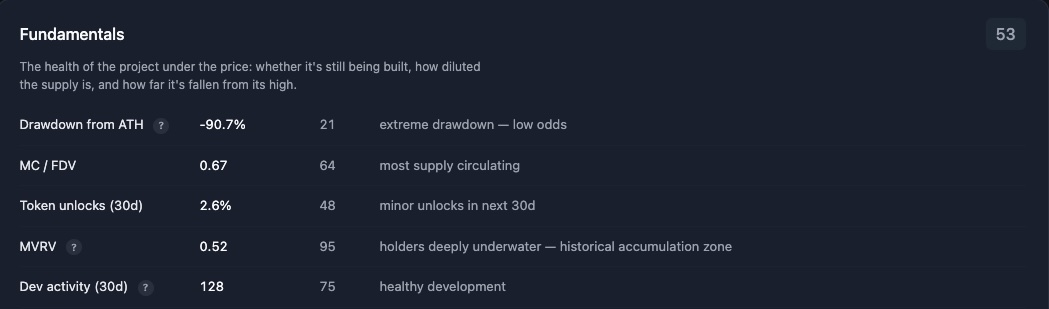
A live way to think about it: 30-day unlock exposure
Most articles stop at definitions. That is not enough. You need the number.
That does not predict price. It tells you how much supply is about to become transferable relative to the size of the market.
The common traps
Trap 1: Looking at FDV and skipping the calendar
FDV tells you supply exists. Unlocks tell you when it arrives.
If you are only reading FDV, you are reading the wrong page of the book.
Trap 2: Counting “unlock %” without considering liquidity
A small percent of supply can still be a big deal in thin liquidity. The reverse is also true.
Trap 3: Assuming recipients behave the same
Some recipients are long-term aligned. Some are not. Some have different cost bases. Some have internal mandates.
You don’t need to moralize it. You just need to know it.
Trap 4: Confusing emissions with “no unlock risk”
Emissions are unlock risk spread over time. It is still supply growth.
Trap 5: Treating one date as the whole story
Cliffs matter. Linear schedules matter too. So does the shape of the next 90 days.
A short checklist you can use on any coin
- What unlocks in the next 30 days?
- Is unlock exposure rising or fading over the next 90 days?
- Who receives the tokens? Team. Investors. Ecosystem. Treasury. Validators.
- How large is it relative to market cap?
- How large is it relative to typical trading volume? (rough is fine)
- If unlock exposure is high, what is your plan? Smaller size. Wait. Or accept the risk.
This is not prediction. It is position sizing.
Where Cyclesolved fits
Unlocks are one risk factor. They are not the whole market.
We track unlock exposure as part of Fundamentals where data is available, alongside other signals. You can see category scores for free on coin pages, and drill into the inputs with Pro.
Start here:
Two example coin pages:
FAQ
What are token unlocks in crypto?
Token unlocks are locked tokens becoming transferable according to a vesting or distribution schedule.
Do token unlocks always cause price drops?
No. Markets can price unlocks early. Recipients do not always sell immediately. Demand can absorb supply. Unlocks are still a measurable risk factor.
What is the difference between vesting and unlocks?
Vesting describes the schedule. Unlocks are the events on that schedule when tokens become transferable.
Why do projects lock tokens at all?
Lockups are a way to stagger distribution. They can align incentives. They can also create future supply risk. Both can be true.
How do I know if unlock risk is “high”?
There is no single threshold. Start with 30-day unlock exposure as a percent of market cap, then look at the next 90 days and who receives the tokens.
No ads. No calls. No hype. No paid coin promotions, ever.
Not financial advice. Educational only.
Get this in your inbox each morning
What changed today, emailed each morning: the scores that moved overnight, your watchlist changes, and what's rated Buy.
Double opt-in. Unsubscribe in one tap.
See this on real coins. Cyclesolved scores every coin in the top 100 across five categories and shows every input behind the number.